
QUANTUM | In Your Words
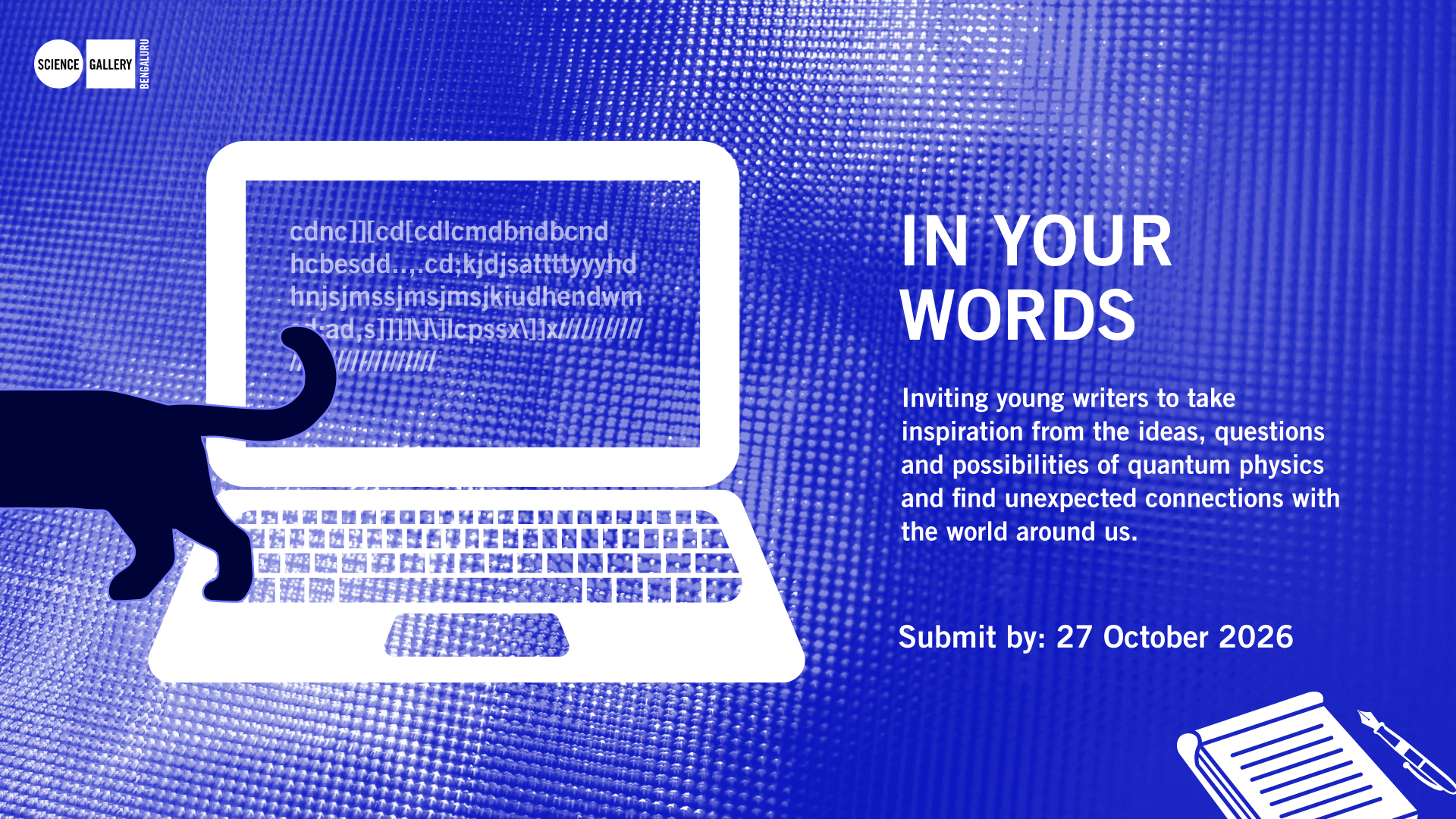
What happens when the world is not quite as certain as we think it is?
Quantum physics has transformed how we understand reality, challenging ideas of certainty, observation, cause and effect. Its concepts can feel strange, even counterintuitive—but they also raise questions that extend far beyond science: Can we exist in multiple possibilities? How connected are we to one another? What can we know, and what remains uncertain? How does our act of measuring change what we see?
As part of our exhibition-season, QUANTUM, we invite writers aged 18–30 to respond to these questions through prose, poetry, creative nonfiction and essays. We are interested in writing that takes inspiration from the ideas, questions and possibilities of quantum physics and finds unexpected connections with the world around us—with relationships, memory, technology, identity, society, or everyday life.
Novelist Anil Menon will provide mentorship and editorial feedback to help chosen writers develop their work. Final pieces will be published in the QUANTUM exhibition reader and presented as part of a public reading.
Timeline
Submissions open: 27 September 2026
Submissions close: 27 October 2026
Writing workshop and mentorship session: 14–15 and 21–22 November 2026
Public reading and showcase: 27 December 2026
Participation Guidelines
The deadline for submissions is 11:30 PM IST on 27 October 2026.
You must be between 18 and 30 years of age to participate.
You must be willing to travel to Bengaluru for the public showcase. Please note that we can only cover domestic travel for selected participants from within India.
You can submit a maximum of three responses per person.
Your submission must be in English.
Please include the title of your work in your submission.
Your submission can either be an Essay or in the form of Poetry.
For Essay Submissions, Word count: 800 to 4,000 words. Choose a length that suits your story—short personal reflections, longer explorations and pieces of fiction are all welcome.
For Poetry Submissions, Length: 10 to 60 lines. This can be one longer poem or up to three shorter poems (total not exceeding 60 lines). Style: All forms are welcome—free verse, spoken word, narrative poetry, haiku, or experimental forms.
Entries must be submitted in .doc or .pdf file formats. The file should be named as follows: YourName_Title_IYW2026
Text within the submission should be formatted in Calibri, size 12.
Submissions are expected to be edited and proofread for grammatical accuracy prior to submission. We are unable to provide detailed, line-by-line edits.
You retain all the rights to your work. By submitting your work, you will give Science Gallery Bengaluru the permission to use and publish your submission during QUANTUM, and your submission will be archived on the Science Gallery Bengaluru website.
Your submission should not have won or placed in other competitions, or have been published in an official capacity in other magazines, exhibitions, etc.
Selected participants must commit to participating in the mentorship sessions and to working with the Science Gallery Bengaluru editorial team on revisions to their piece for inclusion in the QUANTUM exhibition reader.
Prompts
A physicist performs an experiment in which particles are sent through two narrow openings. When no attempt is made to determine which opening a particle passes through, an interference pattern emerges. When the experiment is changed so that the path is observed, the pattern changes.
Describe an experiment of your own. It can be scientific, social, absurd or entirely imaginary. What happens when attempting to get more certainty, the outcomes change?
A photon is the quantum of light—the minimum, indivisible packet of energy that defines its nature. But what is the quantum of human experience? Of human emotions, society, …?
Everything that exists, be it the galaxies, the stars, or the beings on our planet, is the result of a microscopic quantum fluctuation during the first trillionth of a second of the universe, stretched across the cosmos by inflation.
Imagine a civilization that discovers how to read the original text of these fluctuations. They realise that our entire history was written in the static of the Big Bang.
Quantum computers use subatomic physics to process vast calculations at once, rather than one by one. This technology has the potential to transform the fields of encryption, medicine and finance.
What does a world where this technology is democratically available look like?
She could walk through walls. The physicists warned her that every time she passed through matter, there was a tiny probability she would emerge somewhere else entirely.
Somewhere beyond the observable universe, a bubble has formed in the fabric of reality. Inside it, the laws of physics are different. It expands at nearly the speed of light, rewriting the rules of physics. The bubble is already approaching the outer corners of the cosmos. We cannot see it. We cannot stop it.
A line from Italo Calvino’s Cosmicomics:
“Nothing was so beautiful as the thought of the world being made and unmade at every instant.”
A line from Karen Barad’s Meeting the Universe Halfway:
“Reality is composed not of things-in-themselves, or of things-behind-phenomena, but of things-in-phenomena.”
A line from Arundathi Roy’s The God of Small Things:
“That the emptiness in one twin was only a version of the quietness in the other. That the two things fitted together. Like stacked spoons.
An excerpt from “Delhi”, originally published in So Long Been Dreaming: Postcolonial Science Fiction & Fantasy by Vandana Singh
“When he was younger he thought the apparitions he saw were ghosts of the dead, but now he knows that is not true. Now he has a theory that his visions are tricks of time, tangles produced when one part of the time-stream rubs up against another and the two cross for a moment. He has decided (after years of struggle) that he is not insane after all; his brain is wired differently from others, enabling him to discern these temporal coincidences. He knows he is not the only one with this ability, because some of the people he sees also see him, and shrink back in terror. The thought that he is a ghost to people long dead or still to come in this world both amuses and terrifies him.”
An excerpt from a poem, “Small-Scale Reflections on a Great House”, from Relations
Sometimes I think that nothing
that ever comes into this house
goes out. Things that come in everyday
to lose themselves among other things
lost long ago among
other things lost long ago;An excerpt from a poem “The Road Not Taken“, by Robert Frost
“Two roads diverged in a yellow wood,
And sorry I could not travel both
And be one traveler, long I stood
And looked down one as far as I could
To where it bent in the undergrowth;”
ABOUT THE MENTOR
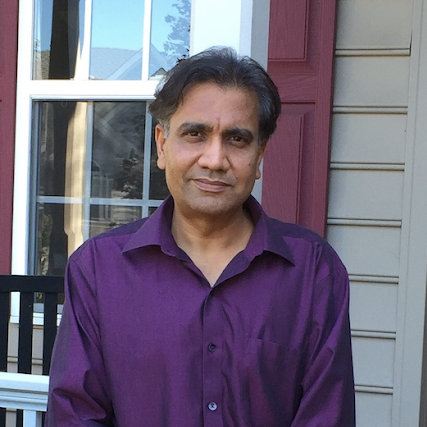
Anil Menon
Novelist, editor
ANIL MENON’s most recent work is the novel The Coincidence Plot (Simon & Schuster, 2023). It was preceded by a collection of his speculative short fiction, The Inconceivable Idea Of The Sun: Stories (Hachette, 2022). He is currently the chief editor of The Bombay Literary Magazine.
ABOUT SCIENCE GALLERY BENGALURU
Science Gallery Bengaluru (SGB) is India's only and Asia's first Science Gallery, a not-for-profit public institution at Sanjaynagar, Bengaluru. SGB was established with the founding support of the Government of Karnataka and academic partners Indian Institute of Science, and National Centre for Biological Sciences. Our work for research-based engagement works at the intersection of science, art, and society to engage young adults through Exhibitions, Public Engagement Programmes, Mentorship Initiative, and a pioneering Public Lab Complex.
For any queries regarding the open call, please drop us an email at programmes@bengaluru.sciencegallery.com.