

STUDENT LEARNING SESSIONS
At Science Gallery Bengaluru, we organise free exhibition experiences for student groups.
If you have any questions, please reach out to us at visit@bengaluru.sciencegallery.com.
Can’t make it to the gallery? You can still explore the exhibition through our virtual gallery walkthroughs here.
Bring your class to QUANTUM.
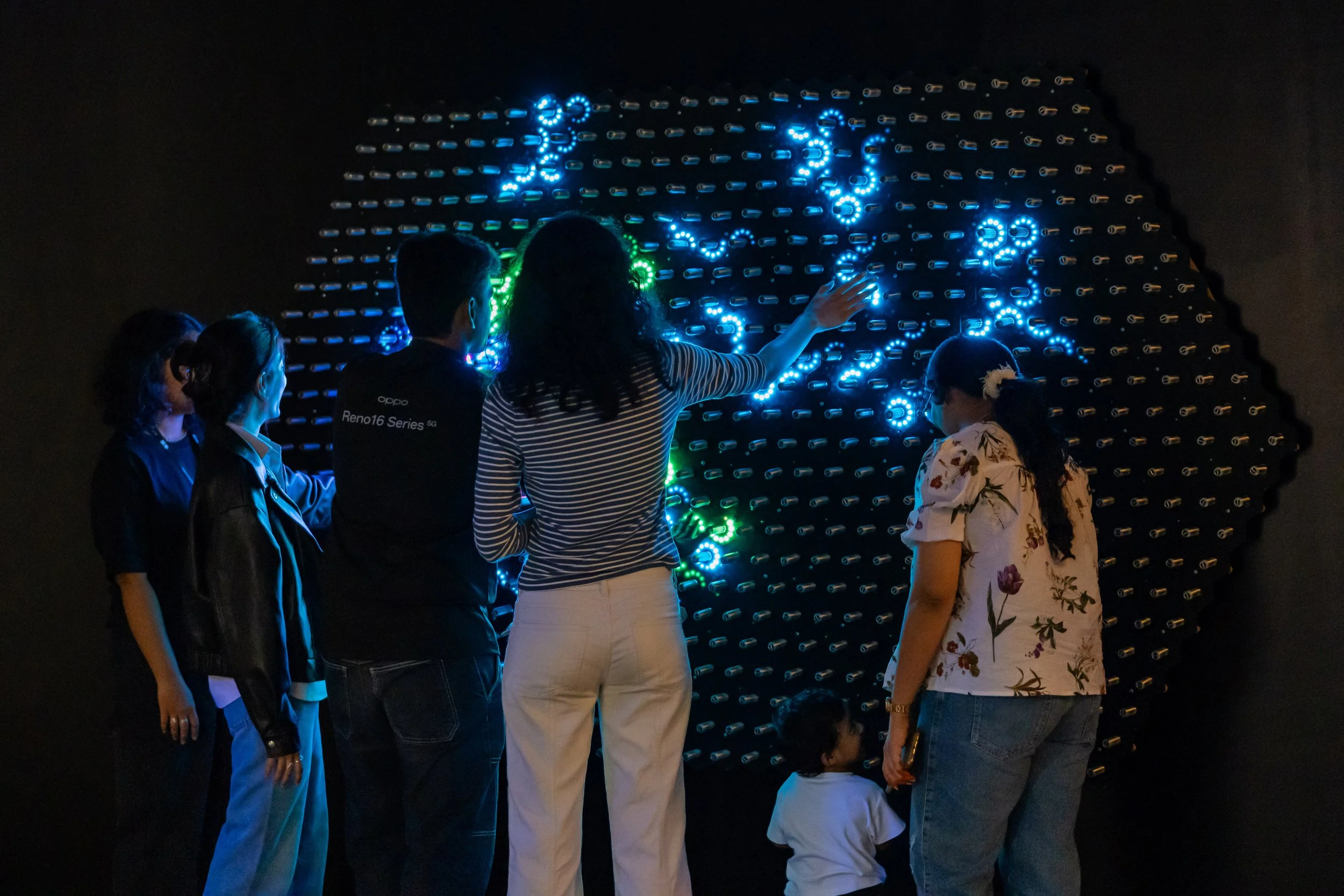
Visitors exploring our current exhibition-season QUANTUM
What if something could be in two places at once? Does light behave like a wave or a particle? How do you observe something you cannot see?
QUANTUM invites students into a world where paradox is ordinary, uncertainty is fundamental, and possibility is ever present.
Through virtual reality, interactive games, immersive art, hands-on experiences (and lots of cats!), students encounter the core ideas of physical science in surprising new ways.
Our Experimentors (trained conversation partners) lead walkthroughs for students from Grades 6 and above, with critical discussions and hands-on activities.
What to Expect
Walkthroughs last about 1.5 to 2 hours.
Students explore 7 to 9 exhibits and discuss key themes.
Depending on the group size, they take part in hands-on activities and reflection sessions.Slots are open from Wednesday to Friday for groups of up to 100 students.
For larger groups, you can book multiple slots.Walkthroughs are available in English and Kannada, with other Indian languages on request.
Key Takeaways
Students will:
Question everyday assumptions about matter, light, energy, and reality.
Discover the strange rules of the quantum world through ideas such as superposition, entanglement, and wave-particle duality.
Explore how scientists develop new ideas by observing, debating, testing, and building on the work of others across generations and cultures.
Reflect on language, art, observation, storytelling, and how they shape the way we understand and communicate science.
Imagine what technologies quantum physics could unlock and the questions it inspires scientists, and students, to ask.
FAQ’s
1. When are Student Learning Sessions (SLS) available?
Student Learning Sessions are available Wednesday to Friday. We currently do not offer SLS on weekends. Click “Request a Slot”, fill in the required details, and select your preferred date and time. Our team will email you within 2-3 working days.
2. Does submitting the request form confirm my booking?
No. Submitting the form does not guarantee a slot. Your visit is confirmed only once you receive a confirmation email from our team.
3. Who can attend a Student Learning Session?
Our Student Learning Sessions are designed for students in Grade 6 and above. We welcome school/college groups visiting as part of an educational experience.
4. Do students need prior knowledge of quantum physics?
No, students do not need any prior knowledge of quantum physics. The session introduces key ideas through interactive exhibits, activities and conversations.
5. What languages are Student Learning Sessions available in?
Sessions are available in English and Kannada. We can accommodate other Indian languages upon request, please specify your language preference when submitting the form.
Locate Us
Gallery Address:
Science Gallery Bengaluru
10—11, Bellary Road
Sanjaynagar Bengaluru 560024
Gallery Timings
Mondays—Tuesday: Closed
Wednesday—Thursday: 10 AM—6 PM
Friday—Sunday: 10 AM—8 PM
DIGITAL LEARNING RESOURCES

The freely accessible Science Gallery Bengaluru Courseware brings together resources from our exhibition-seasons to facilitate non-evaluative, open-ended, and interdisciplinary learning.
We have five modules on Carbon and Climate Change. The first introduces students to climate change and carbon, and the others approach this topic through the lens of biophysics, art, technology, and lived experience. Each module consists of expert-led lecture videos, documentary films, articles to read, as well as exercises and assignments that promote critical engagement with the respective topics.
It is accompanied by an Instructor Guide that you can access here.