
In Focus: Nobel 2025–26
Our annual pop-up on the year’s Nobel Prizes: free public lectures, learning resources and recordings from the 2025 and 2026 series.
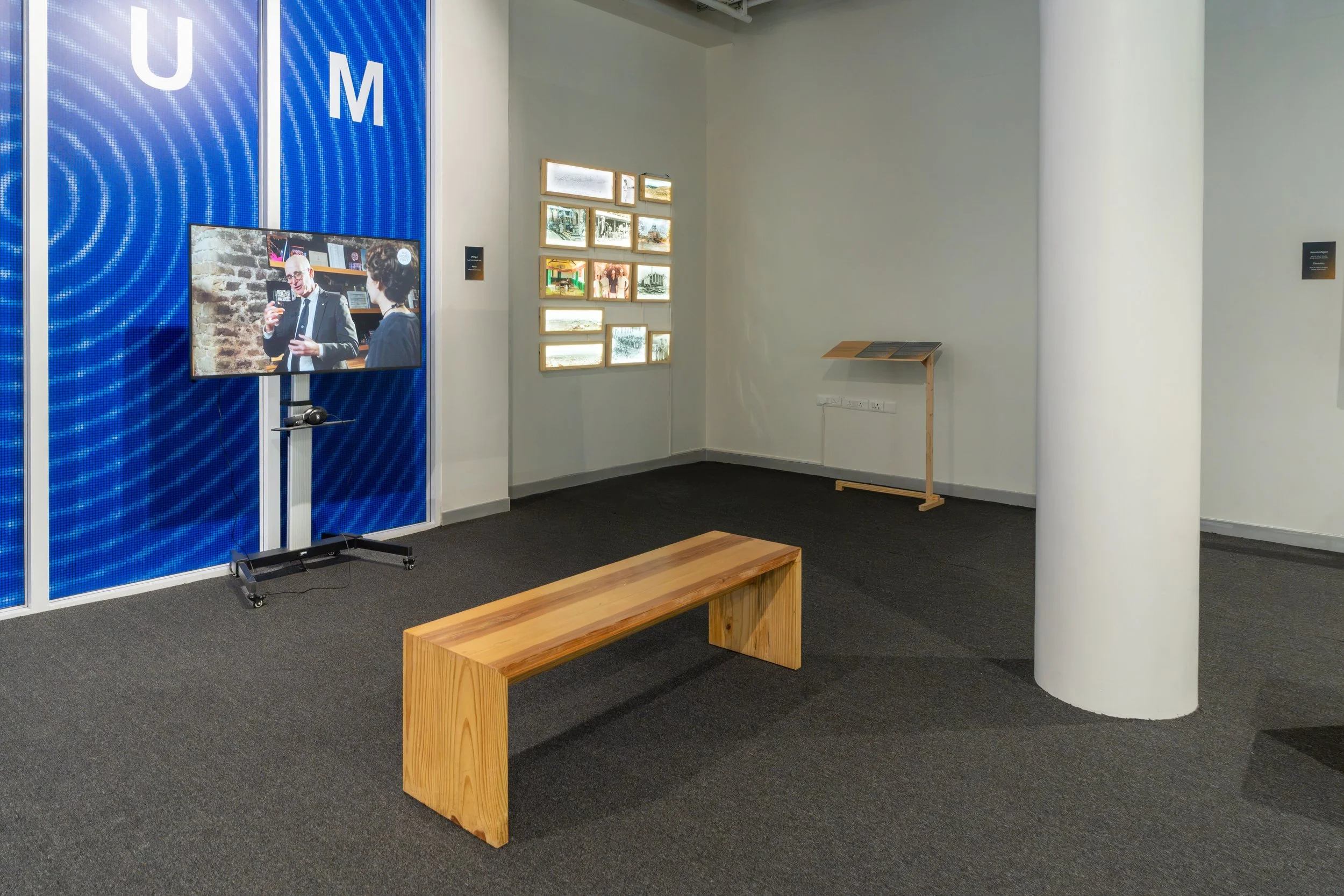
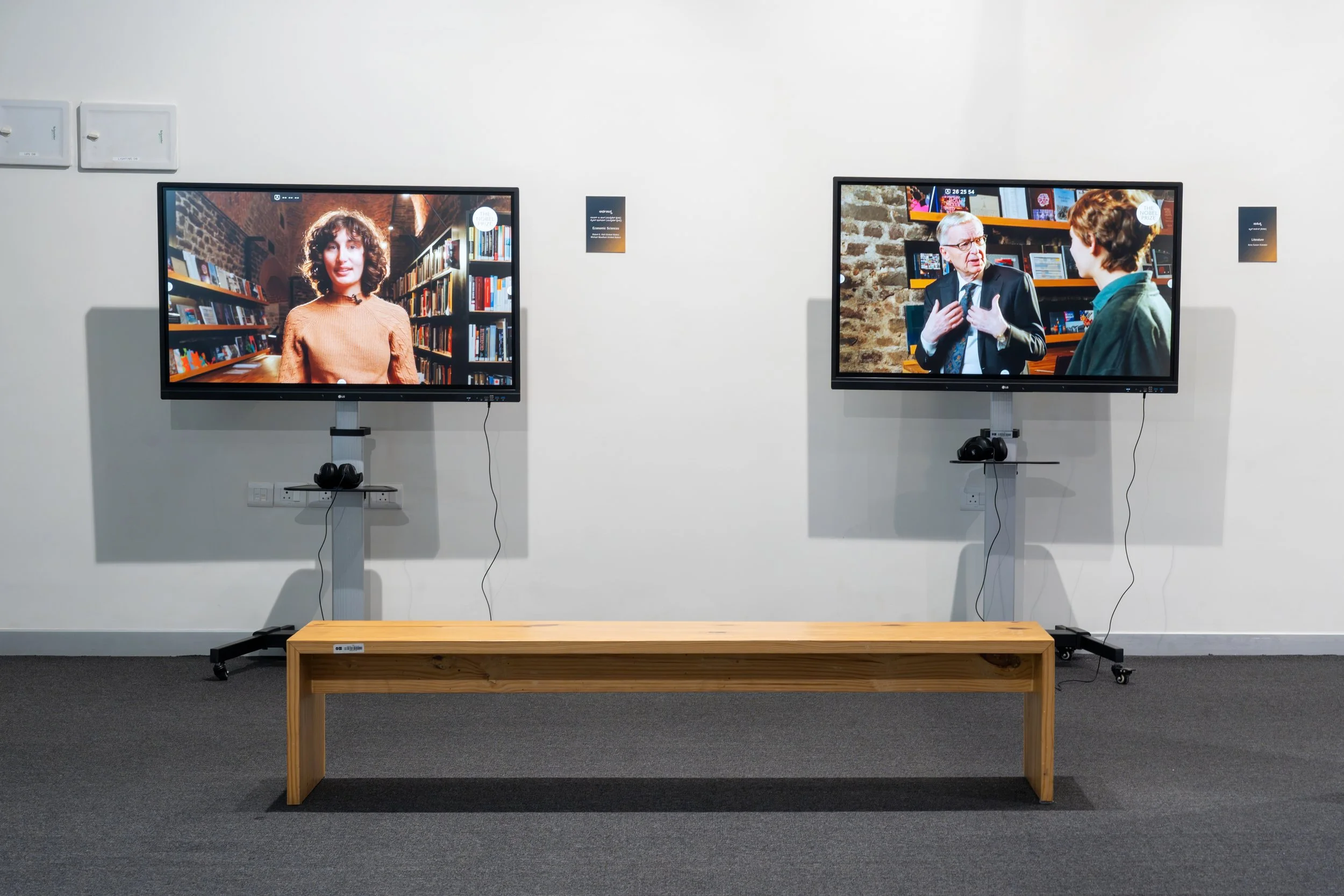
Alongside the theme of our annual exhibition-seasons, the In Focus: Nobel series at the Gallery brings a small in-house exhibit and a series of free public lectures to the Gallery. The lecture series are led by researchers who work in the fields the prizes recognise. It looks at the discoveries and ideas recognised by this year’s Nobel Prizes, through educational resources at the Gallery and a series of expert lectures.
Our In Focus: Nobel 2025 lecture series are now available online!
PROGRAMMES AT THE GALLERY
In Focus: Nobel 2025
Our 2025 lectures ran in November 2025. Watch the full series on our YouTube playlist, and look out for selected talks returning through our From the Archives series.
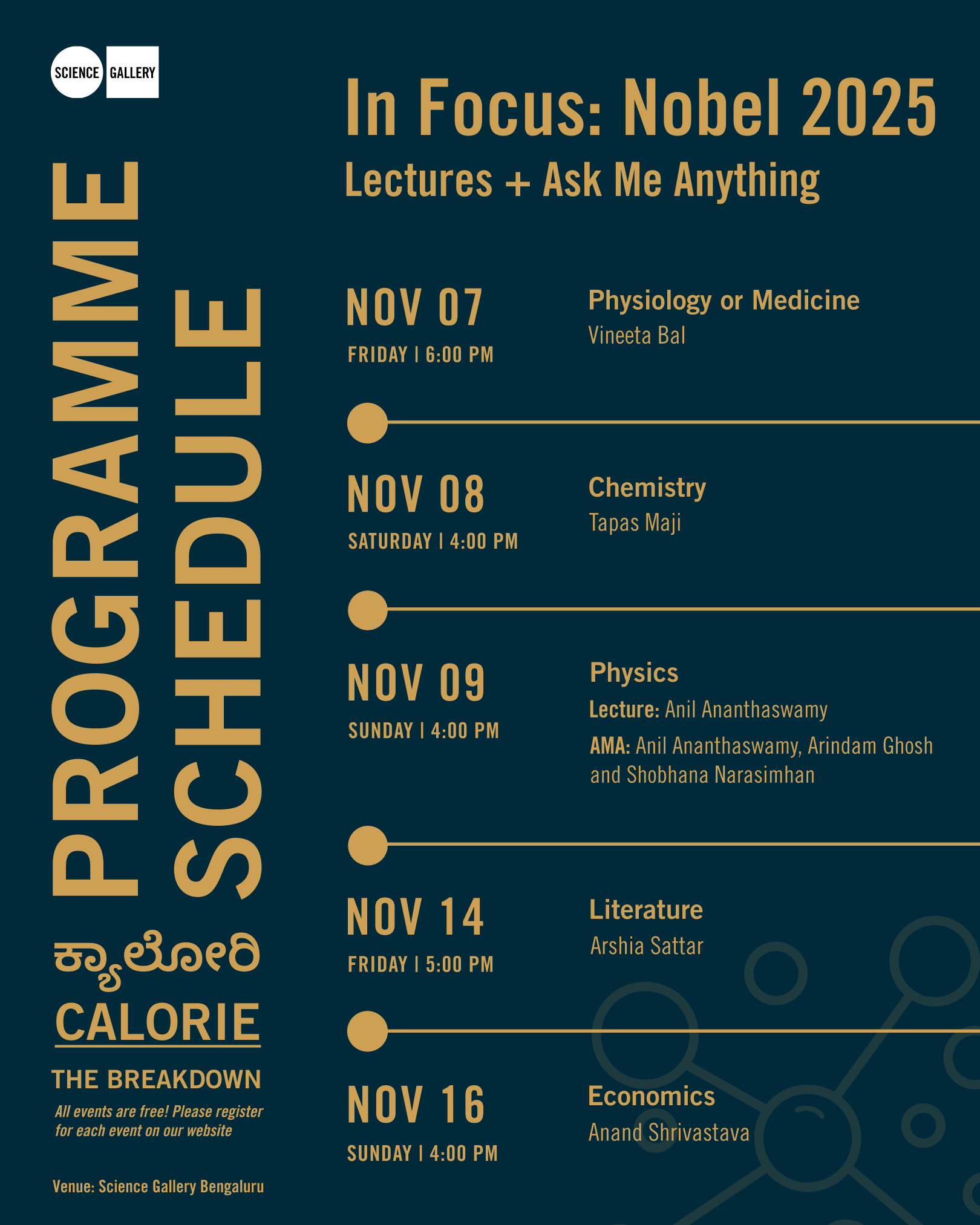
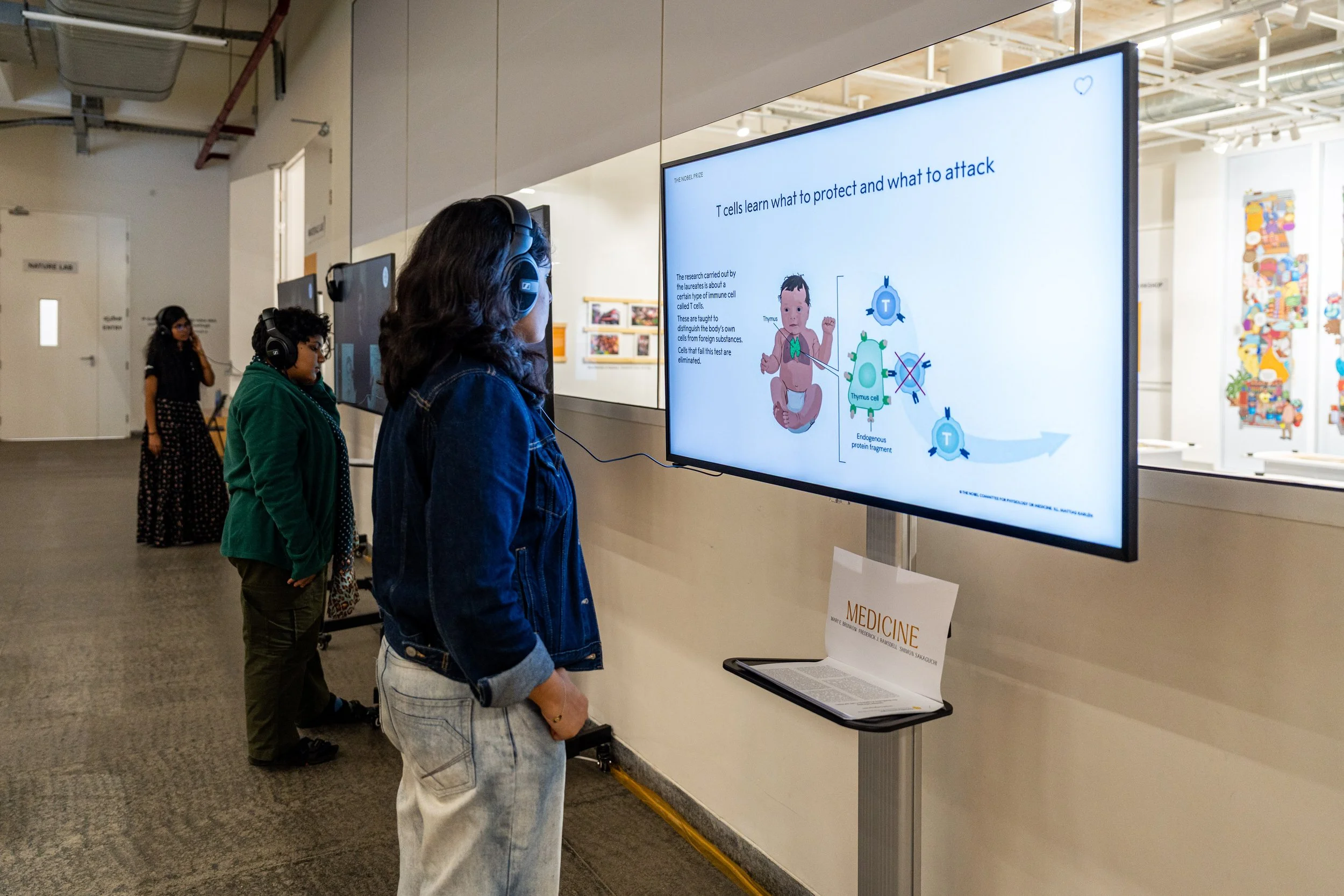
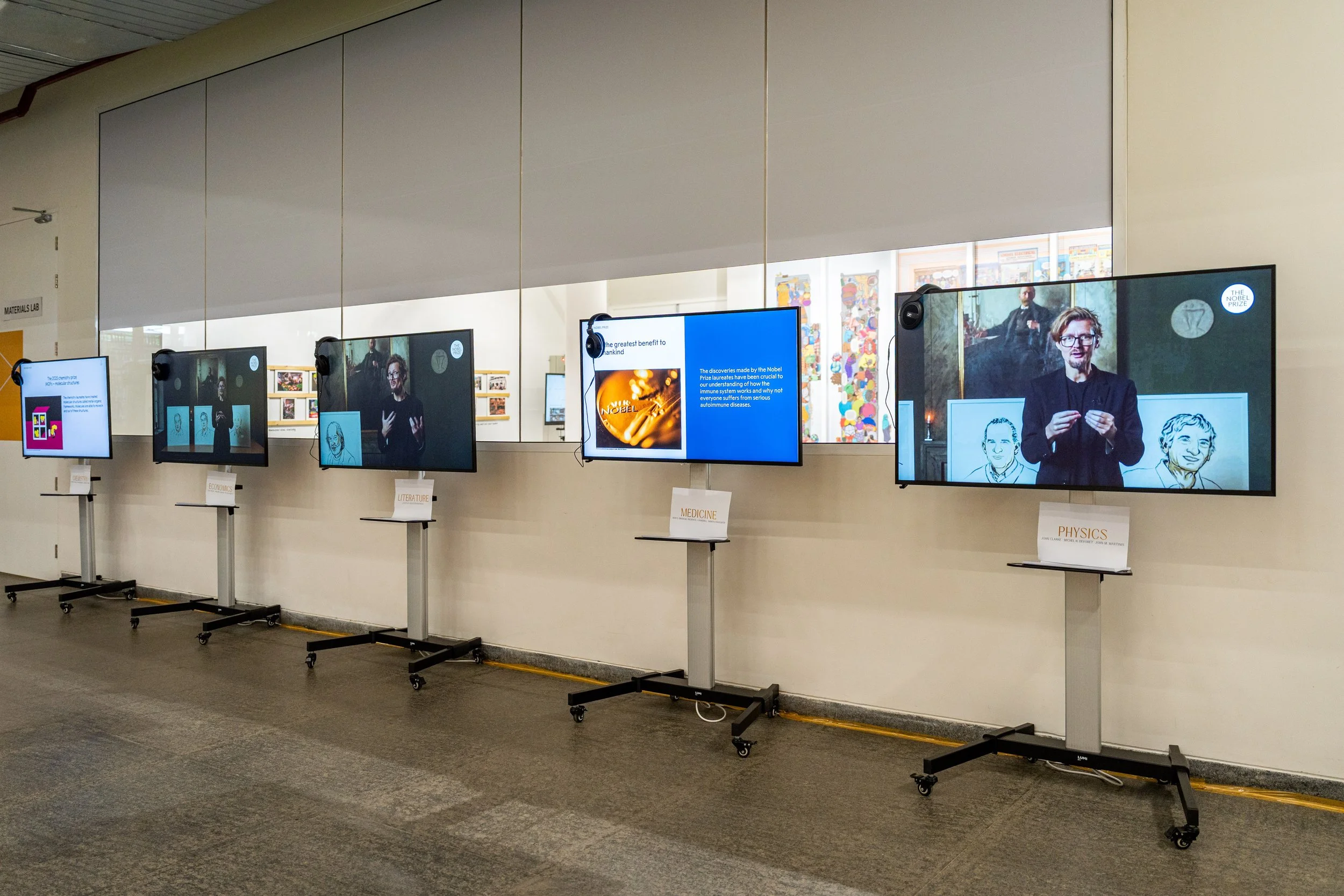
Physiology or Medicine | 7 November 2025
Restrain, Reverse, Regulate
Immunobiologist Vineeta Bal delivered a lecture on the complex mechanisms of the immune system, exploring how our body knows when to stop fighting itself.
Chemistry | 8 November 2025
Metal-Organic Frameworks
Professor Tapas K Maji explored the transformative science of Metal-Organic Frameworks (MOFs): porous materials engineered at the molecular level.
Physics | 9 November 2025
Testing the Boundaries of Quantum Mechanics
Science writer Anil Ananthaswamy and physicists Arindam Ghosh (IISc) and Shobhana Narasimhan (JNCASR) explored the fundamental, and often counterintuitive, boundaries of quantum mechanics.
Literature | 14 November 2025
Eyes on the Prize
Writer and translator Arshia Sattar critically examined the 2025 Nobel Prize for Literature and the broader landscape of major literary awards.
Economic Sciences | 16 November 2025
Innovation and Prosperity
Economist Anand Shrivastava (Azim Premji University) asked what economic growth really means, how it shapes daily life, and what innovation and technology have to do with it.
In Focus: Nobel 2026
From the molecules behind life to the light that switches on brain cells, and the playful mind of a literary laureate, this year’s In Focus: Nobel 2026 series welcomes experts together to bring this year’s Nobel Prize themes to life.
The InFocus:Nobel 2026 lecture series is organised in collaboration with Infosys Science Foundation. The 2026 lecture series are held at the Gallery and are free to register here: https://quantum.scigalleryblr.org/programmes.
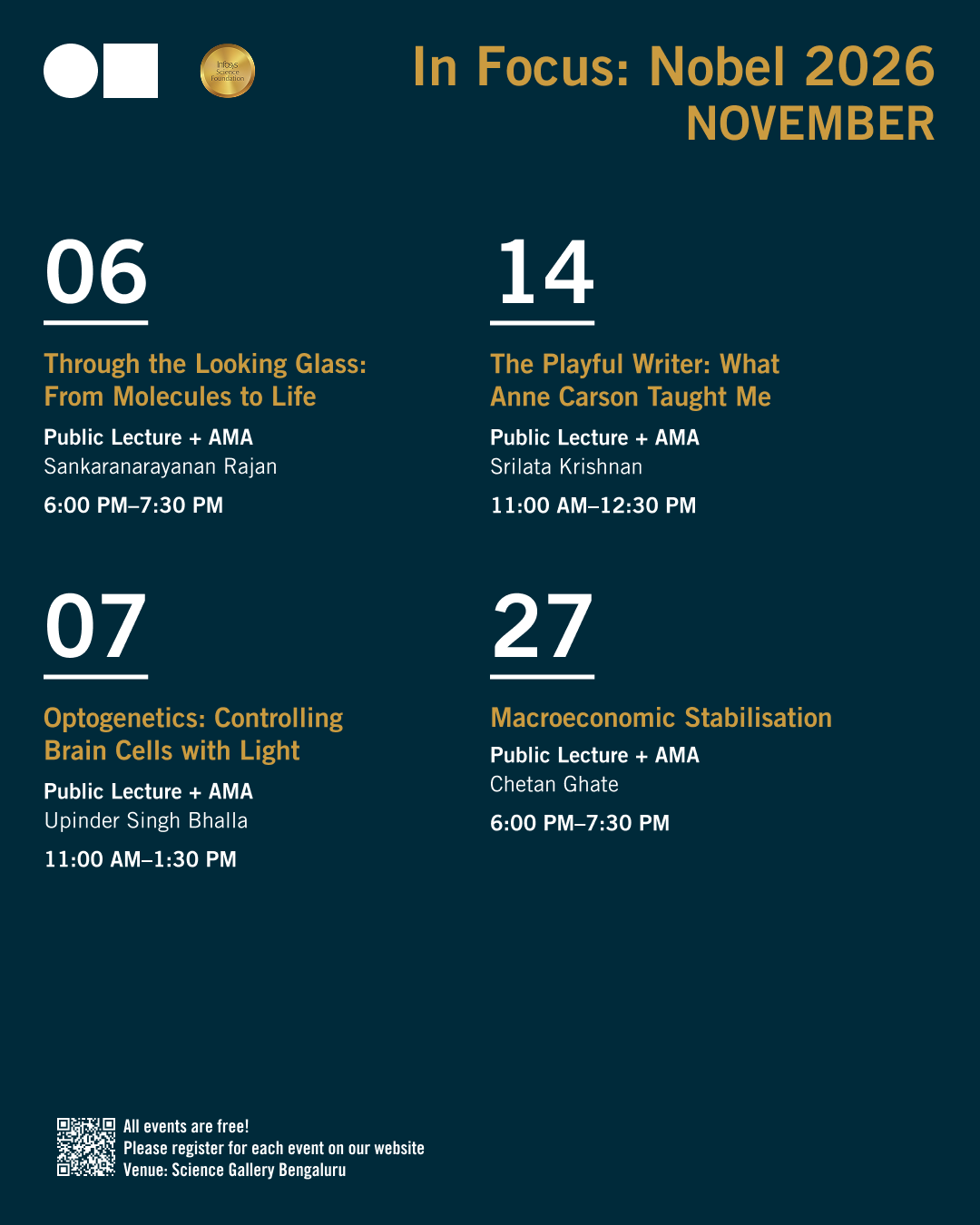
Chemistry | 6 November 2026
Through the Looking Glass: From Molecules to Life
Biologist Sankaranarayanan Rajan traced the evolution of biological systems and molecular chirality, drawing on the work behind the 2026 Nobel Prize in Chemistry.
Physiology or Medicine | 7 November 2026
Optogenetics: Controlling Brain Cells with Light
Neuroscientist Upinder Singh Bhalla (NCBS) traced how basic research on a single-celled organism led to optogenetics, drawing on the work behind the 2026 Nobel Prize in Physiology or Medicine.
Literature | 14 November 2026
The Playful Writer: What Anne Carson Taught Me
Writer Srilata Krishnan talked about Carson’s work and what writers and artists can learn from it. She shared the subtle ways in which reading Carson helped shape her own writing.
Physics | 20 November 2026
Peering Down the Ice to Look at the Sky
Physicist Amol Dighe talks about what the IceCube Neutrino Observatory really is, a gargantuan telescope made from the natural ice block at the South Pole.
Economics | 27 November 2026
Macroeconomic Stabilisation
Economist Chetan Ghate reviews the body of work by the laureates that led to them being awarded the prize in this area.
THE NOBEL PRIZE LEARNING RESOURCES
Explore the free lessons published by Nobel Prize Outreach for every prize. These range from a short slideshow, and reading material, to an expert video and a few questions to think through. The lessons are written for 14–18-year-olds and take about twenty minutes, and there is something definitely for everyone here.
Physics
2025 | Quantum properties on a human scale
John Clarke, Michel H. Devoret and John M. Martinis showed that tunnelling and quantised energy, the stuff of atoms, can appear in an electric circuit big enough to hold. Nobel Prize lesson →
2026 | Elusive particles from space
Francis Halzen turned a cubic kilometre of Antarctic ice into a detector for high-energy neutrinos from the distant universe. Nobel Prize lesson →
Chemistry
2025 | MOFs – molecular structures
Susumu Kitagawa, Richard Robson and Omar M. Yaghi built metal–organic frameworks: crystals full of cavities that gases and other molecules can flow through, with uses from capturing carbon dioxide to harvesting water from desert air. Nobel Prize lesson →
2026 | Molecular mirror images
Henri B. Kagan and Kenso Soai found a solution to a long-standing puzzle of chirality: how chemical reactions can end up favouring one of two mirror-image forms of a molecule. Nobel Prize lesson →
Physiology or Medicine
2025 | The immune system’s security guards
Mary E. Brunkow, Fred Ramsdell and Shimon Sakaguchi identified regulatory T cells, which stop the immune system from attacking the body it is meant to protect. Nobel Prize lesson →
2026 | Groundbreaking brain research
Karl Deisseroth, Peter Hegemann and Georg Nagel: their work on light-gated ion channels led to optogenetics, a way to switch individual nerve cells on and off with light. Nobel Prize lesson →
Literature
2025 | László Krasznahorkai
The Hungarian novelist, known for long, unbroken sentences and apocalyptic themes. Nobel Prize lesson →
2026 | Anne Carson
The Canadian poet, essayist and translator, whose work is in playful conversation with the classical tradition. Nobel Prize lesson →
Economic Sciences
2025 · From stagnation to steady growth
Joel Mokyr, Philippe Aghion and Peter Howitt explained how innovation drives sustained economic growth. Nobel Prize lesson →
2026 · A new model for a stable economy
Robert E. Hall and Michael Woodford built the microeconomic foundations of economic stabilisation: models that show how well-timed policy can smooth out booms and busts. Nobel Prize lesson →